Key Takeaways:
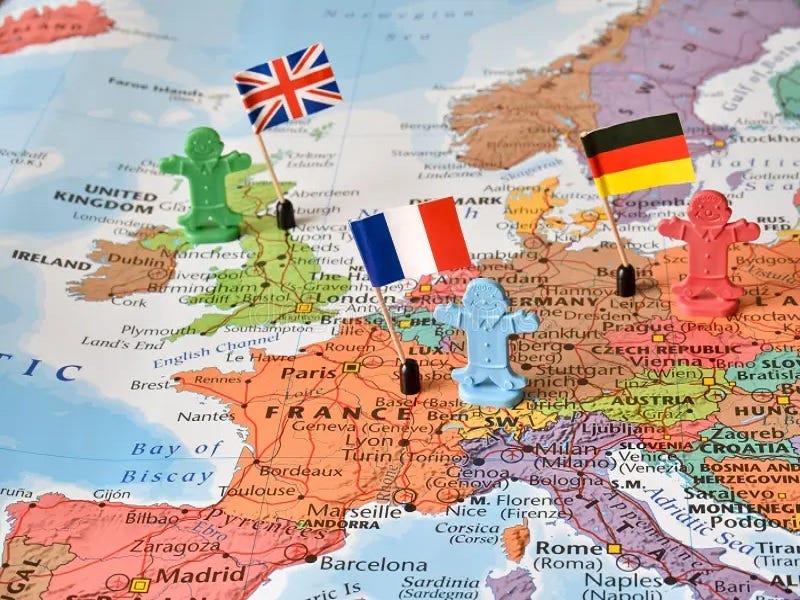
- UK, France, and Germany are establishing military footholds on Russia's borders, from Estonia to Lithuania to Romania.
- Russia perceives this as a coordinated encirclement, potentially leading to a preventive war or subordination.
- A hot NATO-Russia conflict is increasingly plausible if the US does not intervene directly.
The security landscape in Europe is shifting at a frightening pace. Last weekend's surprise call between French President Emmanuel Macron and Belarusian leader Alexander Lukashenko followed ominous warnings from Dmitry Medvedev about Germany's remilitarization. At the same time, the UK is assembling a multinational naval force to contain Russia.
These developments suggest that the traditional European rivals—the Brits, French, and Germans—are now right on Russia's doorstep. The security implications are profound.
The New Geopolitical Chessboard
The UK is entrenching its influence along the Arctic-Baltic front, using Estonia as a base. Germany has opened a tank brigade base in Lithuania. France just announced regular nuclear drills with Poland.
- Estonia borders mainland Russia.
- Lithuania and Poland border Russia's exclave of Kaliningrad and its ally Belarus.
The "military Schengen" between the Netherlands, Germany, and Poland might soon expand to include France and the Baltic States. This would optimize the flow of troops and equipment from Western Europe to Russia's borders.
For Russian policymakers, this matches their worst fears: that the EU is gearing up for a potential invasion. France's base in Romania and military pact with neighboring Moldova only add to the pressure, creating a critical flank in the ongoing Ukrainian conflict.
Germany's Ambitions and Nuclear Threats
Germany aspires to build European NATO's largest army, overtaking Poland. Meanwhile, France and the UK are nuclear powers. The threat of their military-strategic convergence cannot be overestimated.
This could embolden their partners to behave aggressively against Russia, calculating a deterrence of Russian retaliation.
That would be a mistake of epic proportions. Russia cannot allow this to become the "new normal." Such a scenario would weaponize pressure for endless concessions, culminating in Russia's subordination or Balkanization.
A hot NATO-Russian war is likely inevitable, though nobody can say for sure whether the US would help its allies or hang them out to dry.
Three Scenarios Remaining
The security architecture needs reform. Russia sought this diplomatically before the special operation, but its failure led to military action. Now, only three options remain:
- NATO agrees to some form of Russia's proposals.
- Russia launches a preventive war against European NATO, betting the US won't intervene.
- Russia peacefully subordinates itself to the West.
Given the hollowed-out manufacturing and high energy costs in Europe, building a serious threat to Russia would take at least a decade. Yet even a weak party in a geographically favorable position can cause significant harm. Russia is well aware its Kaliningrad enclave and Baltic Sea shipping are exposed.
The clock is ticking. The question is whether the West will realize the danger before it's too late.